
What Makes the Man?
Black Trans Masculinity, Passability, Fetishization and Building Manhood on Your Own Terms

This article is a recap of the latest episode of Assigned Sex, Unarchived, and it opens in the same place the conversation begins: with Kyrie, one of the original cast members from my 2019 documentary Assigned Sex. We met over a decade ago in Brooklyn,NY. At the time, he was in college, early in his transition, and just starting to figure out who he was beyond being an athlete.
On the mic now, he returns ready to talk about what it has actually taken to become a Black trans man on his own terms.
Kyrie’s basketball career ended abruptly once he started testosterone, and that decision cost him more than a roster spot. He lost a built-in community, a language of belonging that had shaped him since he was young. Talking with him now, you can hear both the grief and the growth in his voice, the way that losing that world pushed him to figure out who he was without a jersey, a team, or a ready-made model of Black masculinity to copy.
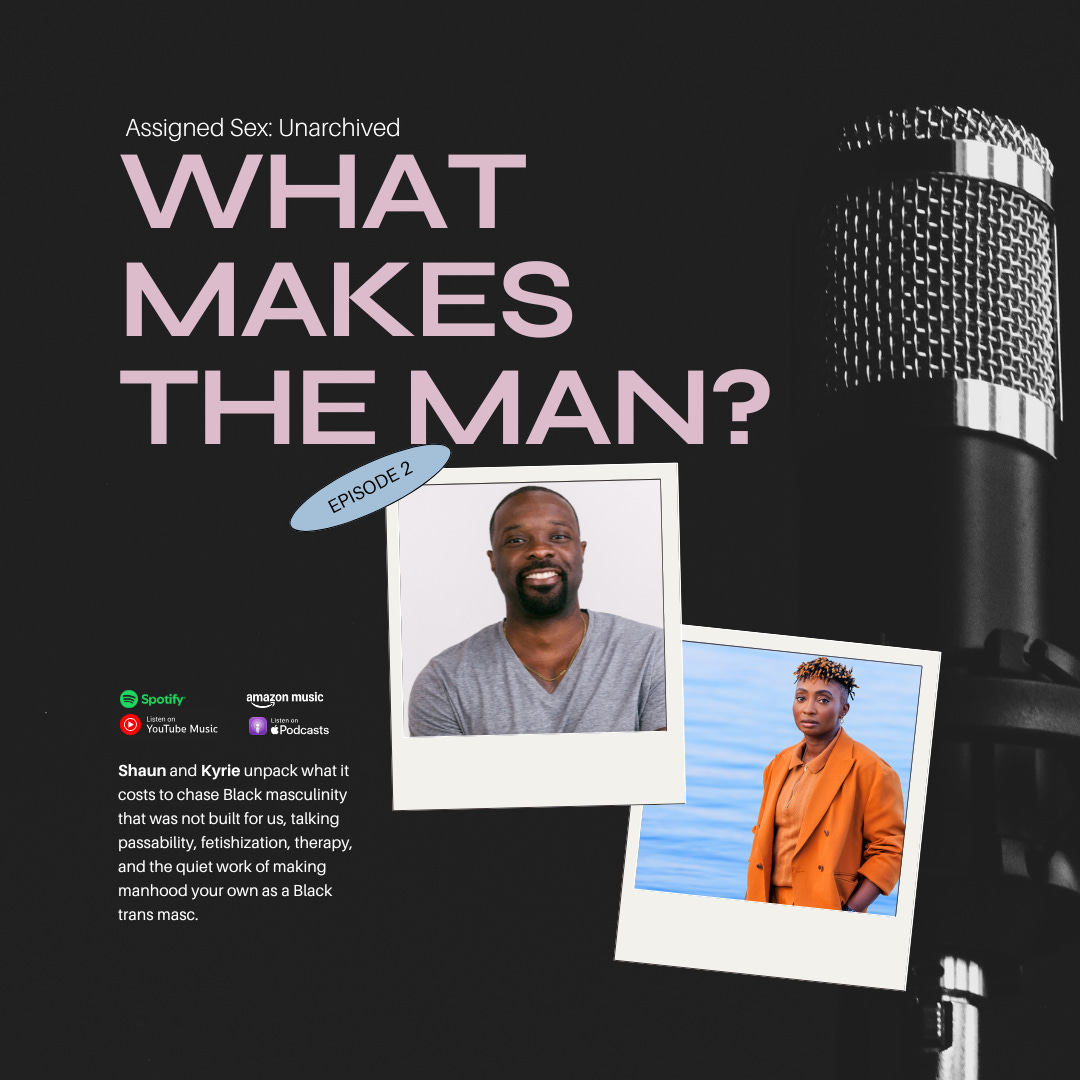
When I ask him what comes to mind when he hears “Black masculinity,” he doesn’t name a person. He names a stereotype. In those first years of his transition, he tried to live inside that stereotype. He tried to be harder, quieter, more stoic, because that was what he thought a Black man was supposed to be, especially in a world that insists softness will get you hurt. Over time, he had to unlearn that performance and ask himself who he wanted to be when no one was watching.
A big part of our conversation lives in that gap between who you are and who you have to be to stay safe. Kyrie talks about what it feels like to be a Black trans man who is read as cis, and how passability can turn you into a ghost. On paper, it looks like an advantage. In practice, it can feel like disappearing. In his motorcycle community in Atlanta, for example, he leaned into a certain kind of masculinity to survive in a space where no one knew he was trans. The act kept him safe, but it also kept him further away from himself.
We also get into dating, and this is where his honesty cuts deep. Kyrie tells me that across years of dating men and women, he has only truly felt wanted for who he is one time. Most of the time, he has had to sort through people who see him as an experiment, a fantasy, or a secret. He has learned to read the signs early now, the way someone’s questions circle around his body instead of his life, the way a conversation tilts toward fetish instead of care. These days, he is open to love but firm about protecting his heart, clear that he wants a partner who chooses Kyrie the person, not an idea of a Black trans man.
In the middle of our conversation, we step back in time and into the story of Jim McHarris, a Black trans man born in Mississippi in 1924. Jim moved through the Midwest working all kinds of jobs, from cook to mechanic to preacher, and lived as a man long before there was mainstream language for what that meant. In 1954, a traffic stop, a bottle of whiskey the police claimed they found, and a forced inspection of his body in front of a judge threatened to unravel everything he had built. The town turned on him once his history was exposed, yet he refused to go back to living as anyone other than himself, reminding us that Black trans and genderqueer people have always been here, building lives in plain sight.
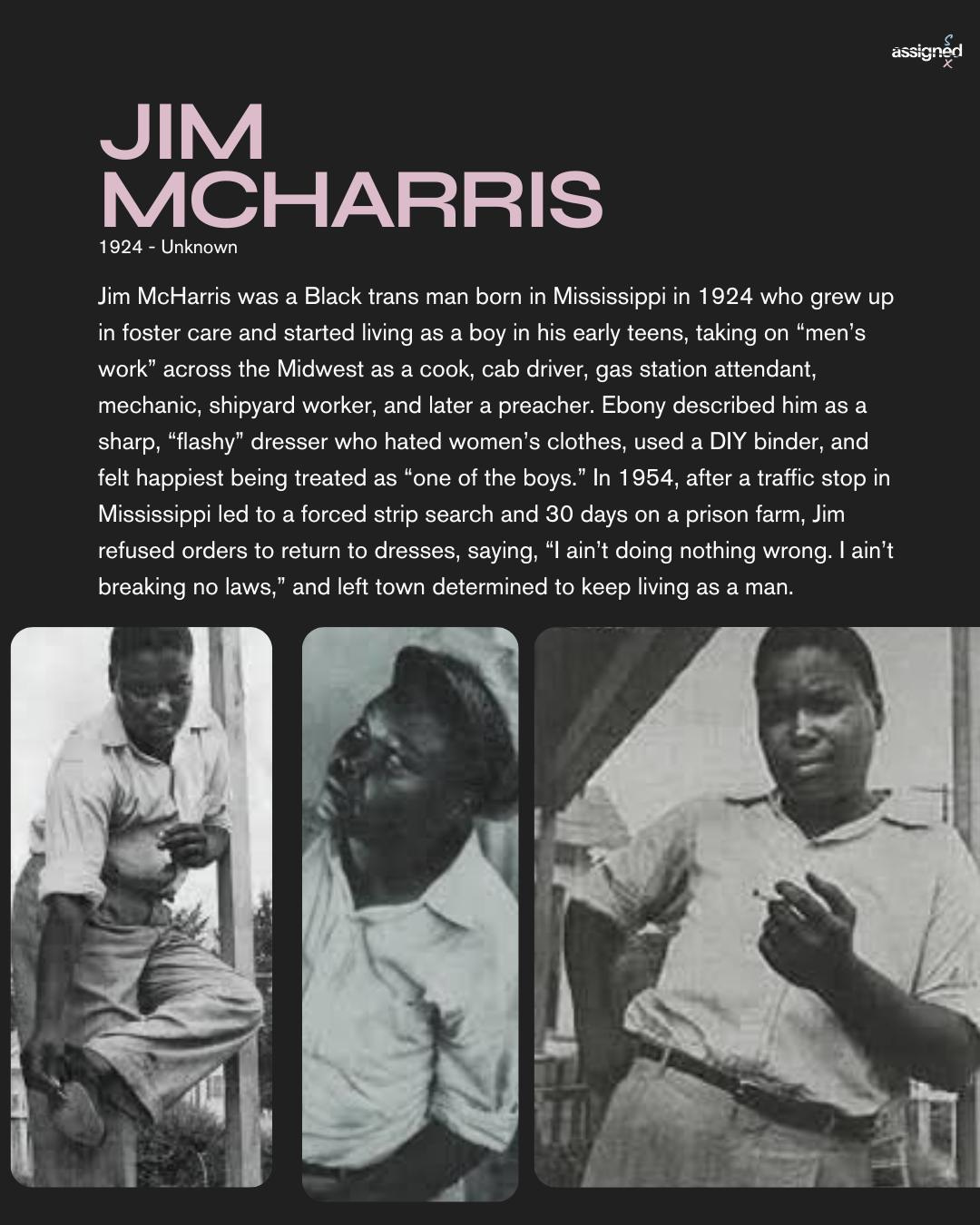
Jim’s story sits next to Kyrie’s in this episode for a reason. The details are different, but both men carry the weight of being seen as “too much” and “not enough” at the same time. Both have had to make choices about when to blend in and when to stand out, when to stay quiet and when to insist on being named as they are. In a political moment where transphobes act like we appeared out of nowhere and try to erase us from classrooms and timelines, Kyrie and Jim’s stories push back with receipts.
Kyrie talks about growing up with almost no positive Black male role models, watching mostly coaches and men from a distance, and realizing later that the upside of that absence was that he eventually had to become his own kind of man. No father’s footsteps to copy. He learned some lessons the hard way, but those lessons pushed him toward a version of masculinity rooted in self-knowledge, therapy, and emotional depth.
Near the end of the episode, I ask him what he would tell a younger Black trans man who is just starting to figure out his gender and sexuality. His answer is simple and direct: make masculinity your own and refuse the stereotypes. Then I ask what he wants from people who love Black trans masc partners. He asks for patience, grace and a willingness to really listen, because there is a depth of feeling and vulnerability many people never see on the surface. He believes in therapy for himself and for partners who say they are “working on themselves,” since no one should have to carry all of that healing alone.
“What Makes the Man” isn’t a neat answer to a big question. It’s a ride through Atlanta on the back of a motorcycle, a childhood spent chasing a ball, a courtroom in 1950s Mississippi, a DM from someone who thinks your identity is a kink, and a mirror you keep returning to until the man you see finally feels like you. If you’ve ever wondered what it takes for a Black trans man to build a life that feels both safe and honest, this one is worth your time.
Hit play on the episode, and then come back and tell me what it stirred up for you.
👉🏾 Listen to Episode 2, “What Makes The Man,” on Spotify, Apple Podcasts, Amazon Music, iHeart or YouTube Music, and follow so you can tap in every time a new episode drops.